


Pickup


Return
🎁 Use code WELCOME3 during checkout to get a discount on your first booking with us. Enjoy! ☀️

Car rental in Albania is the honest way to see the country in a single trip. The narrow coastline from Shkodër to Ksamil, the mountain villages of the north, ancient Berat in the south, the lacework of roads up to Lake Komani — by bus, that's a logistical puzzle with two services a day. By car, it's a relaxed five-to-ten-day loop.
The TakeCars catalogue holds 727 cars in Albania from dozens of local partners. Low-season prices start at €12 a day, peak summer from €30. One of the cheapest rental markets in Europe — and there's room to pick a compact for the alleys of Tirana or a crossover for Theth and Valbona.
A couple flew into Tirana last May, picked up a Fabia at the gate, and were in Berat for lunch. The whole handover took eight minutes on the bonnet.
The local market runs on cash. The deposit and most of the rental are paid in euros or lek straight to the host; the card only covers the online prepayment. For visitors arriving by ferry from Bari or by flight from across the EU and the UK, it's straightforward: book online, bring a small stack of euros for the rest.
We show the deposit amount, the payment method and real photos of the actual car upfront. No "I booked X but got Y" moment at the desk.
Seasons and prices
Albania has two clear seasons and the gap between them is nearly double. Low season runs October to April: economy from €12 a day, wider choice, quiet roads. Peak is July and August: the same model starts at €30, and in Ksamil and Himarë the best automatics go a month ahead.
The sweet spot is May and September. The sea is warm either side of summer, prices sit 30–50% below August, and you skip the wave that turns parking in Durrës or Sarandë into a half-hour hunt.
For July and August, book at least three weeks ahead. Not a marketing line — there are simply no automatics left in the popular classes.
Length matters too. A weekly rental usually carries a 15–25% discount on the daily rate; a month gets you 40–50%. Driving the whole country? Pick the car up at Tirana airport and drop it in Sarandë rather than juggling short rentals from different cities.
A family of four took a Skoda Octavia from TIA to Ksamil last August at €47/day. Public transport for the same route would have cost more once luggage transfers were counted.
What else moves the price: Super CDW (€10–25 a day), young-driver fees, cross-border permission, one-way drop-off. All visible in the quote before booking.
Most tourists in Albania start their trip here
Picking the car
Albanian city geometry shapes the choice. The old centres of Tirana, Berat and Gjirokastër were built for small saloons. Sarandë and Ksamil in summer mean dense traffic and rare parking. The most common request: a compact hatchback or B-class — Skoda Fabia, VW Polo, Hyundai i20, Kia Picanto.
Heading north to Theth, Valbona or Lake Komani? Look at a crossover or SUV with a diesel engine. Mountain switchbacks and long climbs reward diesel torque and ground clearance. A petrol compact will manage, but with five up and luggage it's at the limit.
A guest took a Polo to Theth in June. It made it both ways, but the brakes were hot by the time the road levelled out. The next year, same guest, same trip — diesel crossover.
Families and groups of three or four sit better in the mid-size class — VW Golf, Ford Focus, Skoda Octavia. The boot fits suitcases and beach gear, the A/C copes with August. For couples without children, a compact is usually the answer: more agile, cheaper to run.
Roughly one in three of our Albania renters picks an automatic. Manual on mountain climbs is fine in itself — but if you haven't shifted in years, a holiday is the wrong place to relearn.
EVs are still rare in Albania: few chargers, routes outside Tirana hard to plan. Pragmatic pick: petrol economy or diesel mid-size.

Volvo V60 in Albania
Overall, I was very satisfied: the rental agent was helpful and polite! I had reserved a Volvo V60 with a manual transmission, but they brought me a Jetta with an automatic transmission. I was pleasantly surprised.

Hyundai Santa Fe in Albania
Everything went well, thank you.
Volkswagen Touran in Albania
IT was very bad experience
Volkswagen Golf 5 in Albania
just to let you know we are very desapointed with the car. First of all we asked for a golf 5 and we had a Touran which is more bigger and not modern. We did not have diesel inside when we get it and had to fill full,this is not really helpfull. Climatisation do not work well and we cannot charge our phone and no GPS inside. You must precise it before we book car. Moreover, we have a lot of signal light as oil to contrôle, airbag failure..we are not safe at all with this car. We also left with half a tank of gas, even though we had started with a car that barely had any gas!

Mercedes-Benz Vito in Albania
Was great!
Volkswagen Golf 6 in Albania
Very good, for my next trip I will use also this company

Volkswagen Golf 6 in Albania
All good, thank you.
Hyundai i30 in Albania
Everything went very well. The landlord is great! Very satisfied. It wasn't a Hyundai, it was a Golf.
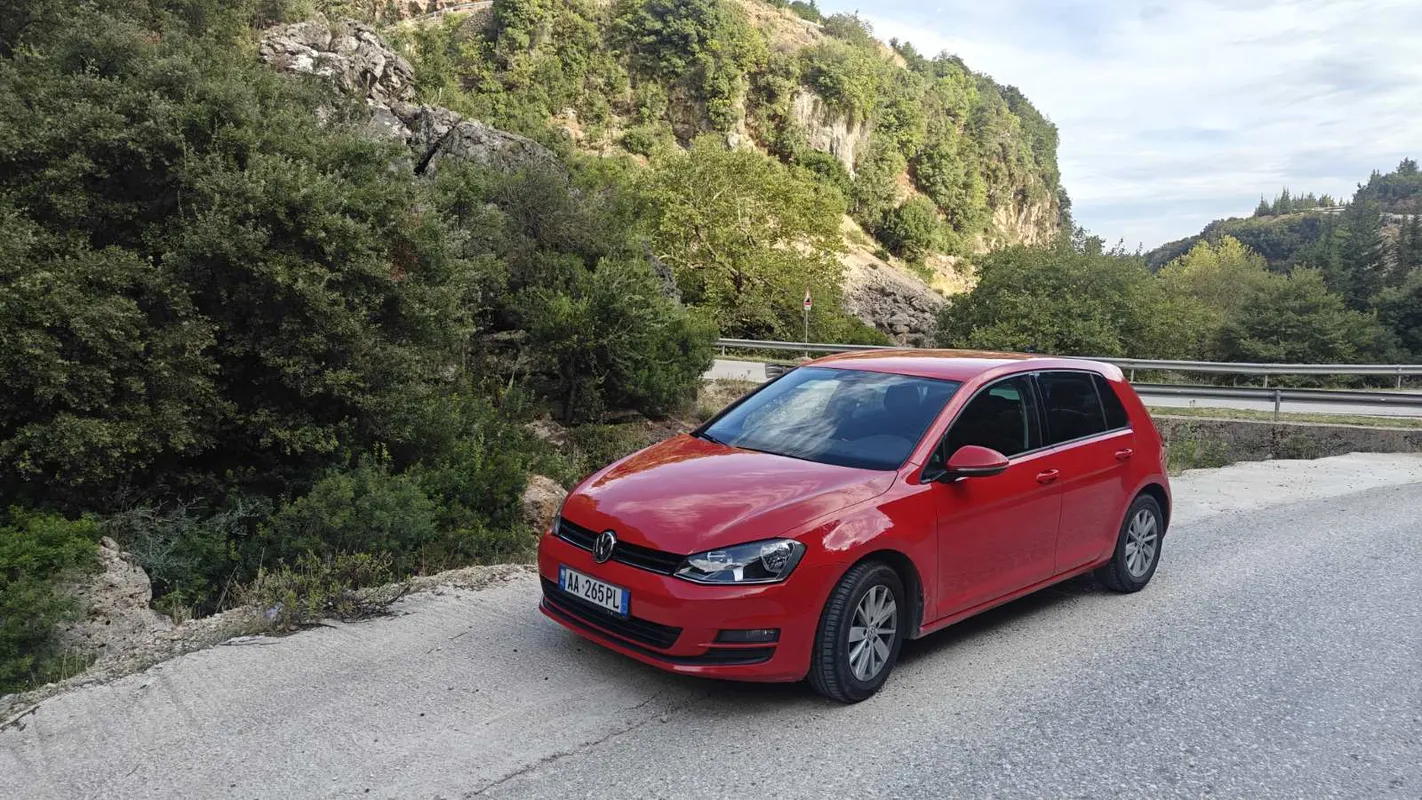
Volkswagen Golf Plus in Albania
Everything was very good. Thank you!!!!
Skoda Fabia in Albania
We are very pleased with the rental. The gentleman who served us was very helpful and friendly. He took great care to make sure we understood everything well. We highly recommend renting from this company. The cars are clean and well-kept. The Skoda we rented was very economical. Fuel consumption below 4 liters. We will recommend this company to all our friends. Thank you very much

Volkswagen Golf 5 in Albania
Everything went smoothly and with no problems

Ford C-Max in Albania
The truth is that it was not the best of sensations...to begin with, I seem to remember that we chose the Full-full fuel option and they delivered it to us with only a few km and to return we had to adjust the quantity; It also had a bad reverse gear and it was very difficult to put it in, which was not very safe and then we did not know that they managed private vehicles. For the rest, they tried to make the management as good as possible and after other difficulties in understanding each other, everything was arranged well. Overall good, but I would like more transparency from the beginning... Thank you.

Mazda CX-7 in Albania
Was ok Thanks

-
Real reviews on every car
You see ratings and comments for the exact vehicle you're booking, not just the company's average.
-
Cash deposits, no card hold
Most local partners take €100–300 in cash at pickup; several hundred cars in the catalogue run on a zero-deposit tariff.
-
Free upgrade if your class is full
If your chosen model is already out, the host bumps you to the next class up — no extra charge, no negotiation at the desk.
Documents and deposit
To rent in Albania you need a passport with the entry stamp, a driving licence and a bank card for the prepayment. EU/EEA, UK and most Latin-script licences are accepted by local suppliers, though an International Driving Permit (IDP) is recommended for non-EU visitors.
An IDP costs around £5–€10 and takes a couple of days. For a first trip to Albania, it's one possible roadblock removed.
Visa and entry
EU/EEA and UK citizens enter visa-free for up to 90 days. US, Canadian and Australian citizens — up to a year. For most other passports, an e-visa is available via e-visa.al for around €30.
Card or cash
Albania is a cash country. The deposit and the bulk of the rental are paid in euros or lek to the supplier. The card is used only for the 15–20% online prepayment. Withdraw euros at home or at Tirana airport ATMs.
Deposit €100–300, or zero
Local suppliers usually ask for €100–300 cash on collection. International chains block €250–1500 on a credit card. Rather not lock funds? Pick a "no deposit" tariff — several hundred such cars are in the catalogue.
A cash deposit comes back on the spot when you hand the car over, provided there's no damage. Faster than waiting for a card hold to clear — with some banks that takes weeks.
Insurance in Albania
Every rental car in Albania carries TPL (Third-Party Liability) by law. It covers damage to other people, vehicles and property — not your rental. Basic cover alone is rarely enough.
Basic CDW
CDW comes in most tariffs with an excess of €500–1500. It rarely covers tyres, wheels, windscreen, undercarriage or interior — exactly the parts that take the worst beating in Albania. Patchy asphalt, coastal gravel and old-town kerbs wear them down fast.
A couple took the basic CDW in March and clipped a stone on the Llogara descent. Windscreen wasn't covered. The repair cost almost as much as the rental.
Super CDW
Super CDW removes the excess and in most packages covers tyres, glass and the underbody — €10–25 a day. For city trips basic cover is fine. For Theth, Valbona or the Llogara pass, take Super CDW.
Full Damage Waiver
Full Damage Waiver is offered by some partners and covers most edge cases — lost keys, towing, chipped paint. Whatever the cover, any scratch or accident means calling the police on 126 or 112. Without a report, no insurer pays.
Even in an empty car park: spot a fresh dent or scratch on the car, call the police, get it logged. Ten minutes of waiting saves hundreds of euros down the line.
Roads, rules and borders
Main roads and the Tirana–Durrës motorway are of European quality. In the provinces and the mountains, stretches can be under repair, and the habit of stopping mid-road "for a minute" applies everywhere.
Speed and alcohol
In town 40 km/h, rural roads 80, A1 110. Alcohol limit is 0.01‰, effectively zero: one glass means a €250–400 fine and possible licence suspension. Dipped headlights must be on day and night, year-round, since 2023.
The single most common reason a foreign car gets pulled over is daytime headlights left off. Fine €20–40, easiest paid on the spot. Most of our cars switch them on automatically.
Tolls and parking
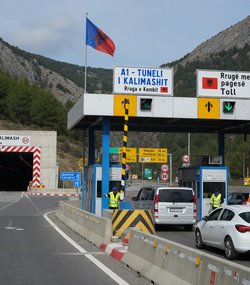
The only toll is the A1 "Rruga e Kombit" with a booth at the Kalimash tunnel on the way to Kosovo, €5 per car. No national vignette. In Tirana, blue zones are paid via the T-Park app.
Where to start
The most popular scenario is car rental in Tirana at TIA airport. If you start on the beach, car hire in Durrës is handier. For the south, the starting point is car rental in Sarandë — close to Ksamil and Butrint.
From Albania you can reach Kosovo, Montenegro, North Macedonia and Greece in a day. Make sure the cross-border permission stamp is in the contract — without it the insurance lapses at the frontier.
Rates in Albania vary throughout the year depending on the season and the rental length in days.
- January
- February
- March
- April
- May
- June
- July
- August
- September
- October
- November
- December
- Jan
- Feb
- Mar
- Apr
- May
- Jun
- Jul
- Aug
- Sep
- Oct
- Nov
- Dec
 How expensive is renting a car in Albania: average daily rates for a one-week car rental, across all car classes. Delivery across Albania not included.
Frequently asked questions about car rental in Albania
Yes. With most local TakeCars partners, you use a card only for the 15–20% online prepayment. You can then pay the remaining balance and deposit in cash, in euros or Albanian lek, when you collect the car. EU and UK debit cards are also widely accepted. International chains are more likely to require a credit card, but many local suppliers do not.
No. The ferry company does not allow rental cars on board — this is the operator's rule, not the rental supplier's. Park the car in a paid lot in Sarandë (€5–10 a day) and travel as a foot passenger. The crossing costs €19–35 one way and takes 30–70 minutes depending on the vessel.
Yes. EU and EEA licences are accepted without any additional documents. Most local suppliers also accept UK, US, Canadian and Australian licences written in the Latin alphabet. We recommend carrying an International Driving Permit as well, as the police may ask for one during a roadside check.
There is no fixed seasonal requirement; whether winter tyres are needed depends on the road conditions. Winter tyres marked M+S are strongly recommended from November to March if you plan to drive to Theth, Valbona, Korçë or the northern mountains. Studded tyres are banned throughout the year. In summer, summer or all-season tyres are suitable for driving along the coast.
A litre of 95 petrol costs around €1.60–2.10, while diesel is slightly cheaper at €1.50–1.80. LPG is widely available, although rental cars rarely use it. Fuel stations are common along the coast and the Tirana–Durrës motorway, but less frequent in the mountains. Fuel is noticeably cheaper in Kosovo and North Macedonia.
Yes. Almost every supplier uses the "full-to-full" rule: you receive the car with a full tank and return it the same way. Top up 5–10 km before the return office and keep the receipt. If you bring it back with less, the supplier will refuel at a marked-up rate plus a €15–30 service fee.
Yes. Almost all our partners offer one-way rentals within Albania. The surcharge is typically €20–80 for routes between Tirana and Sarandë, Vlorë or Gjirokastër. International one-way rentals to Podgorica, Dubrovnik or Pristina cost around €300–600 and are available from only a small number of suppliers. The fee is shown in the quote before you book.
Most cars in the catalogue come with unlimited mileage, which is standard in Albania. A limit of 150–250 km per day may apply to long-term rentals of 30 days or more and to some luxury cars. If there is a mileage limit, it will be shown on the car page. Additional kilometres usually cost €0.15–0.30 each.
Yes. Children under three must use an appropriate child seat, and children under 12 or shorter than 150 cm cannot sit in the front. The fine is €50–100. Our partners offer child seats for €5–10 per day or €30–50 for the entire rental. Book one when you reserve the car, as availability can be limited in summer.
No. Most rental agreements prohibit smoking, carrying pets without prior approval, and eating strongly scented food in the car. Breaking these rules may result in a cleaning fee of €50–150. If you plan to travel with a dog, contact the rental manager in advance. Some partners allow pets but may require an additional cleaning deposit.
Yes. The minimum rental period is usually 24 hours from the collection time. A delay of up to one hour is often allowed at no extra charge; after that, you may be charged for another day. A few small local suppliers require a minimum rental of three days, particularly in high season, but they account for less than one fifth of the cars in the catalogue.
A passport with the entry stamp, a driving licence in Latin script and a bank card for the online prepayment. An IDP is recommended for non-EU visitors. If you add a second driver, bring their licence too — at local suppliers this is usually free, while international chains charge €3–7 per day.
Fines are paid at any Posta Shqiptare branch, at a bank, or by card with the officer if a terminal is available. Pay within 15 days of the offence and a 50% discount applies. If a fine remains unpaid, the rental company will charge it to your card after return, plus a €10–30 admin fee.
At the airport you usually pay €3–8 a day more because of the airport surcharge. If you are staying one or two days in Tirana before driving on, picking the car up in town saves money. If you are heading straight out across the country, taking it at TIA saves you an hour and €15–20 on a taxi.
The standard minimum age is 21, and you need at least one year of driving experience. For premium cars, the minimum age may be 23–25. Drivers under 25 may also pay a young-driver fee of €3.50–10 per day, or a flat fee of around €50. This is added at the rental desk and shown in the quote before you confirm. There is no upper age limit in Albania.