


Pickup


Return
🎁 Use code WELCOME3 during checkout to get a discount on your first booking with us. Enjoy! ☀️

Car rental in Portugal is less an extra and more a condition: half of the country simply does not fit into a holiday plan without it. The high-speed train between Lisbon and Porto is genuinely useful, but Sintra, the Douro vineyards, the Alentejo's whitewashed villages, the Algarve cliffs and Cabo da Roca — the westernmost point of mainland Europe — all begin where public transport ends.
Portugal is compact and very varied at the same time. In a single day you can drop from granite mountains onto the Atlantic sand, drive through pine forests and olive groves, and stop for lunch in a family taverna in a hill village of two hundred people. A car gives you time, and time in these places is worth more than money.
Portugal does not like to be rushed. Given the choice between a motorway in ninety minutes and the coast road in three hours, I almost always recommend the second — that is where Portugal actually happens.
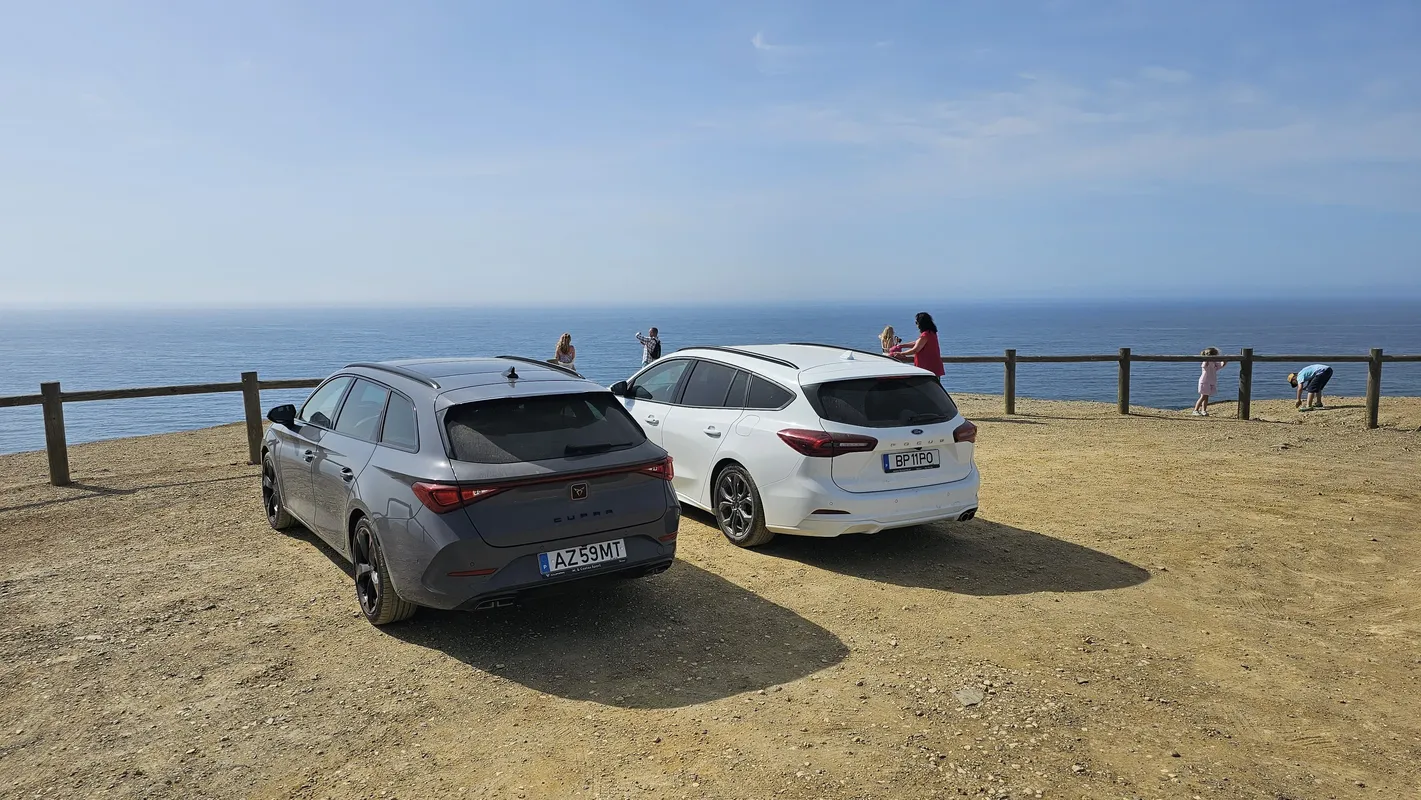
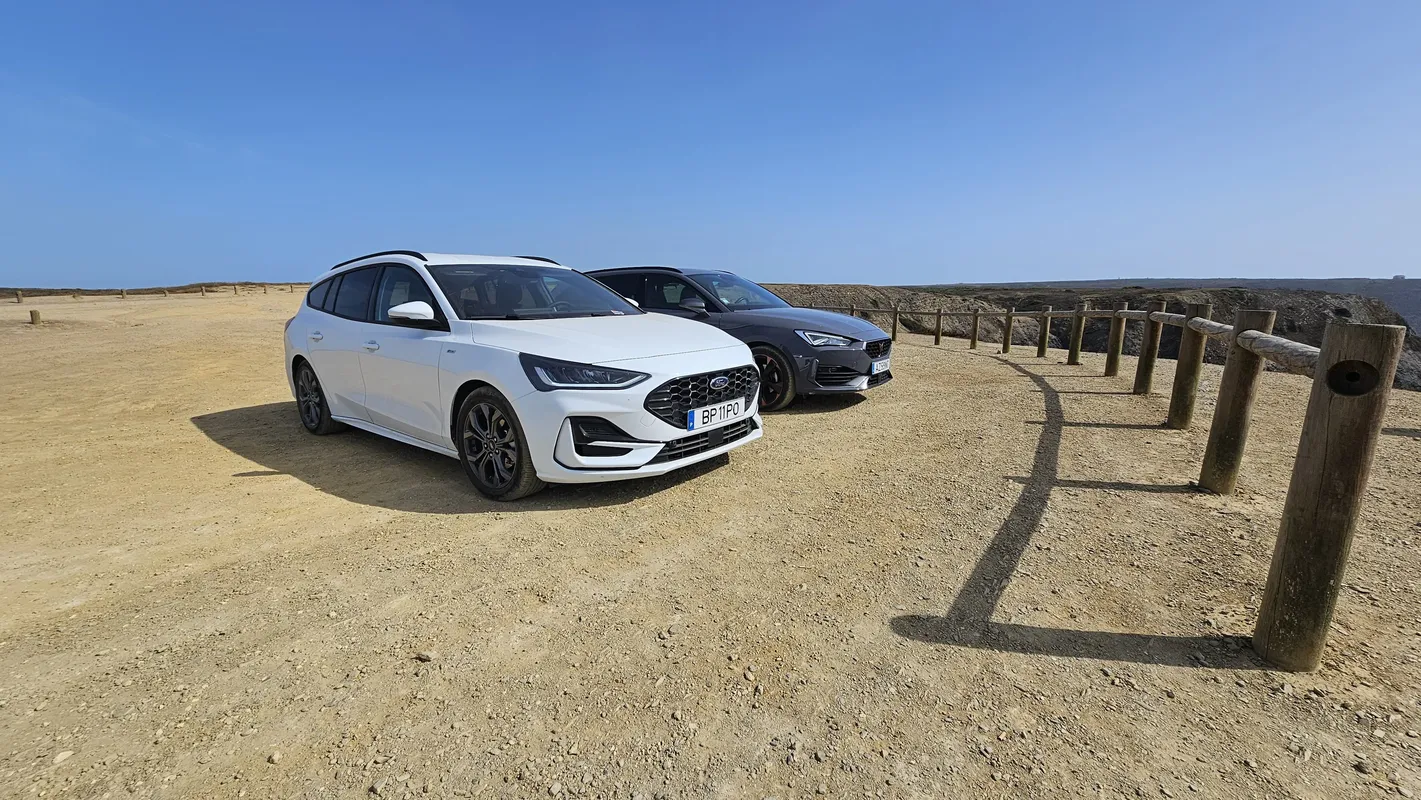
Most of our travellers choose a specific car in advance from real photographs of the actual vehicle, not stock images, and read the previous renters' reviews on the same page.
A useful rule for a first trip is not to try to see everything in a week. Pick one side of the country and drive it slowly, rather than racing between the Algarve and the Douro on the motorway.
For a first visit pick one region, settle into it for four or five nights, then add a second only if you genuinely have time. Driving Portugal slowly is part of the country, not a cost of seeing it.
Where a car earns its keep
In central Lisbon and Porto a car creates more problems than it solves. The metro, tram 28, taxis and Bolt cover almost everything, while Alfama and Ribeira are built for people and trams, not parking. Between the two cities the easiest option is the high-speed train — three hours and around €25.
For two days in Lisbon or Porto the car usually sits unused on a paid car park. I advise picking it up on the day you leave for Sintra, Cascais, the Algarve or the Douro.
Car hire in Lisbon and car hire in Porto are most often booked not for the cities themselves but for the side trips: Sintra, Cascais, Cabo da Roca, the Douro Valley and Peneda-Gerês.
For the Algarve a car is even more essential. Car hire in Albufeira or car hire in Faro opens up dozens of coves between Lagos and Sagres that buses either skip or visit only every few hours.
The Algarve by car and the Algarve by bus are two completely different countries. Most of the prettiest beaches do not appear on any timetable — you reach them on a dirt track.
Car hire on Madeira is a separate story: the island cannot be covered without a car, and mainland suppliers do not operate there, so a Madeira hire is booked on the island itself.
Browse cars in popular areas
Most tourists in Portugal start their trip here
Choosing a car for your route
Portugal works very well on small hatchbacks: a Renault Clio, Peugeot 208, Fiat 500, VW Polo or Hyundai i10. In the historic centres of Lisbon, Porto and Évora a parking space is often the width of a single step, and a large car turns every day into a struggle. Hatchback prices start from €20–25 a day in low season and rise to €25–35 in peak season.
In Alfama and Ribeira parking spaces are the size of one small car. An SUV cannot squeeze in next to the kerb, and you spend every evening looking for somewhere else. A hatchback is simply more comfortable here.
If your route includes hills — the Douro, Gerês or the Serra da Estrela — a diesel or a small SUV makes more sense. Pulling power matters more than engine size on those climbs, and a diesel uses on average a quarter less fuel. A mid-range crossover costs €45–70 a day and pays for itself on the Madeira hairpins.
I always suggest a diesel for routes that include the Douro or Gerês. On a steep climb a weak petrol engine paired with an automatic gearbox will tire you out faster than the climb itself.
A manual gearbox is 15–25% cheaper than an automatic and gives more control on descents. Most contracts include unlimited mileage, but it's worth checking the tariff fine print.
The deposit amount and the way it is taken are visible on the car page before you book, so there are no surprises with that figure at the desk and the contract carries no small print.

Peugeot 5008 in Portugal
everything went great, thank you!
Kia Ceed SW in Portugal
Originally I booked a Kia Ceed SW, but the car was replaced with a Fiat. The car was clean and in good condition. The pickup and drop-off process was very quick and simple, and everything went smoothly. Overall, I had a positive experience and would be happy to use your service again. Thank you!

Fiat Panda on Madeira
We are very satisfied with the car rental. The car is in good condition and clean. The owner was as polite as possible and arrived on time.

Fiat Panda in Portugal
Everything was good and the car pickup and return were very convenient.

Volkswagen Polo in Portugal
The car is very nice, clean! The new technology makes itself felt! (adjusts speed, corrects traffic). We got the rental car quickly! Within an hour it was delivered directly to the hotel! The employee was very kind, explained everything! Transfer of the car to the owner - no problems were not! All on trust! I think we justified it! Deposit was minimal, which suited us as travelers, but comfort - maximum! This company can be trusted!
Fiat 500 in Portugal
All it perfect
SEAT Ibiza in Portugal
Loved everything, great car, quality service from the provider and good support
Kia Picanto in Portugal
Everything went perfectly, the owner brought the car to the house as agreed. Within 10 minutes we had the documents drawn up. I didn't take a deposit, we did with human trust. Picked up the car also from home. Loyal owner, by agreement changed the time of issuance and delivery of the car. I recommend

Fiat 500 in Portugal
Very good communication with the car rental company, Mr. Bruno.
Volkswagen Polo in Portugal
everything was great, everything went well!
Kia Ceed SW in Portugal
It's a nice car. Comfortable and convenient. Rental service met all my needs. No complaints at all. The rental process was easy and convenient. Thank you. Highly recommended. I liked that you can rent a car for cash.

Ford Focus SW in Portugal
Everything went great, thank you very much!

-
Via Verde is already fitted in every hire car
You do not need to buy a transponder separately or detour to avoid tolls; a 2023 law requires every rental company to install the device on every vehicle.
-
Gasolina is petrol and Gasóleo is diesel
The words look almost identical, but filling the wrong one costs €500–2000 in tank cleaning, recovery and operator fees.
-
You may only park in the direction of travel
If a free space is on the opposite side of the street, you have to drive on, find the next roundabout and turn around; crossing the road to park is not allowed.
Toll roads, Via Verde and free-flow gantries
Portugal is one of the few European countries where the toll-road transponder must, by law, be installed in every hire car. This is set out in Decree-Law 84-C/2022 and has been in force since 8 January 2023. Nothing to buy or register on arrival.
How Via Verde works
The transponder is fixed behind the windscreen and read on the move. At a toll point you take the green Via Verde lane at up to 60 km/h. The hire company charges a daily service fee of €2–4 and bills the actual journeys.
The Via Verde transponder works automatically. Toll charges show up either on the final invoice or as a separate card payment within three to five days.
Invisible electronic tolls
In the south you find free-flow roads — the A22 in the Algarve and stretches of the A4, A24 and A25. There are no booths or barriers, only cameras on the gantries. Without Via Verde such a journey is, by default, a fine.
The A22 in the Algarve has no booths or barriers, only cameras on the gantries. With Via Verde everything is debited automatically.
How much popular routes cost
The A1 between Lisbon and Porto is three hours and €21.90. The parallel N1 is five hours and zero euros. With time in hand the second is often more interesting.
Lisbon to Porto on the A1 is around €21.90 one way. Lisbon to the Algarve on the A2 is around €30. The alternative is the parallel N-series roads: the same Lisbon–Porto trip on the N1 takes five hours and is free.
Driving routes in Portugal
The main rule for any Portuguese road trip is not to try to do it all. Roads, vineyards and viewpoints slow down any timetable.
Lisbon — Sintra — Cascais
Pena and Regaleira palaces in the morning, then Cabo da Roca and back via Guincho into Cascais. About 60 km loop. Car hire in Lisbon is the natural fit.
Sintra in the rain is almost like Hogwarts. In dry weather set off by eight: after ten the palace car parks fill up and the Regaleira queue is an hour.
The Douro Valley
From Porto along the N108 to Peso da Régua and Pinhão — about 120 km between vineyard terraces. After that the N222, one of the finest roads in Europe. Car hire in Porto for the Douro is essential.
The Douro is the kind of valley you want to stop in every five minutes. Between Pinhão and Régua there are several viewpoints worth a small detour.
Algarve
200 km of south coast: coves, Ponta da Piedade, Benagil, Carvoeiro. Car hire in Albufeira or car hire in Faro keeps things flexible.
The best Algarve beaches are not on any bus timetable. You reach them on a dirt track, and often find yourself alone on the sand.
Alentejo and Madeira
Alentejo is plains and white hilltop towns. Car hire on Madeira is booked on the island; mainland suppliers do not work there.
Rates in Portugal vary throughout the year depending on the season and the rental length in days.
- January
- February
- March
- April
- May
- June
- July
- August
- September
- October
- November
- December
- Jan
- Feb
- Mar
- Apr
- May
- Jun
- Jul
- Aug
- Sep
- Oct
- Nov
- Dec
 How expensive is renting a car in Portugal: average daily rates for a one-week car rental, across all car classes. Delivery across Portugal not included.
Frequently asked questions about car hire in Portugal
Citizens of the EU, EEA, UK, Switzerland and many other countries, including the US, Canada, Australia, New Zealand and Japan, can visit Portugal without a visa for up to 90 days in any 180-day period. Other travellers must apply for a short-stay Schengen visa through a Portuguese consulate or visa application centre. The fee is around €90, and processing can take up to 45 days. A valid Schengen visa issued by any member state can be used to enter Portugal.
EU, EEA, UK, US, Canadian, Australian and New Zealand licences are accepted directly with no further paperwork. Any licence printed in the Latin alphabet is generally fine. Always carry the original licence in the car along with your passport and the rental agreement — these are routine items at any roadside check.
You do not normally need an International Driving Permit if your licence is written in the Latin alphabet, including licences from the UK, EU, US and Australia. An IDP is recommended if your national licence uses another script, such as Cyrillic, Arabic, Chinese characters or Greek. Always carry the original licence with any IDP.
The standard minimum is 21 years with at least one year of driving experience. A young-driver surcharge of €10–25 a day applies under the age of 25 — somewhat higher than the European average. Premium and SUV categories often require the driver to be 25 or over with three years of experience. The upper age limit is usually 70–75.
Via Verde is the Portuguese electronic toll transponder. Since January 2023 it has been fitted by law in every hire car — you do not buy or register anything separately. The hire company charges a daily service fee of €2–4 and bills the actual tolls. At a toll point you take the green Via Verde lane at up to 60 km/h.
Yes. Most motorways have a slower, toll-free N-road alternative. For example, Lisbon to Porto takes about three hours on the A1 and costs €21.90 in tolls, while the N1 takes around five hours and is free. The N-roads pass through more towns and can be scenic. Select ‘Avoid tolls’ in your navigation app and check the route before setting off.
A small hatchback costs around €20–25 per day in the low season and €25–35 from June to September. A mid-size SUV is usually €45–70 per day, while premium cars cost €80–200. At Lisbon Airport, a small car can cost more than €90 per day during the busiest weeks. For summer travel, booking at least two to three weeks ahead usually gives you a better price and choice.
Most rental agreements allow travel to Spain, while other EU countries, including France, may require prior approval. Some rates include a one-off cross-border fee of €50–150. Via Verde works only in Portugal; Spain uses the VIA-T system, although some newer transponders are compatible with both. Confirm the countries and toll arrangements with the supplier before travelling.
No. Portuguese rules require you to park facing the direction of travel. If an empty space is on the opposite side of the road, continue to the next safe place to turn around and approach the space from the correct direction. Visitors may be unfamiliar with this rule, so pay attention when parking on two-way streets.
The usual speed limits are 50 km/h in towns, 90 km/h on rural roads and 120 km/h on motorways. Motorways also have a minimum speed of 50 km/h. The blood-alcohol limit is 0.5‰, equivalent to 0.05% BAC, and a stricter limit of 0.2‰ applies to drivers with less than three years of experience. Speed and alcohol checks are common, and speeding fines range from €60 to €2,500.
Madeira and the Azores are a separate hire market: mainland suppliers do not operate there, and the car must be booked on the island itself. On Madeira a hatchback or compact crossover handles the hairpins and tunnels best. On the Azores small SUVs and occasionally four-wheel drive are useful. Prices are similar to the mainland, but the choice of cars is smaller.
Call 112, the European emergency number. Do not move the vehicles until the police arrive unless they are blocking traffic. Photograph the vehicles, damage, number plates and road conditions, and complete a Declaração Amigável, the European accident statement. A police report is mandatory if anyone is injured, and the insurer may reject a claim without the required documentation. Notify the rental company within 24 hours.
Gasolina means petrol and gasóleo means diesel. Because the words look similar, check the fuel type carefully before filling the tank. Using the wrong fuel may cost €500–2,000 in cleaning, recovery and administration fees. Check the pump label and octane number, and confirm the required fuel when you collect the car.
Most international brands require a credit card for the deposit. Local partners are often more flexible: you may pay a 15–20% prepayment online, then pay the balance in cash or by debit card when you collect the car. Depending on the supplier, the deposit may be paid in cash or held on a card. The accepted method is shown on the car page before you confirm.
The standard deposit is €500–2,000. It is held on a credit card and generally released within 3–14 working days after you return the car. Some local partners require as little as €300, and no-deposit options are available when you choose full insurance with no excess. The exact amount and payment method are shown on the car page before booking.