


Pickup


Return
🎁 Use code WELCOME3 during checkout to get discount on your first booking with us. Enjoy! ☀️

Car hire in Alicante is the natural way to unlock a coastline that runs for hundreds of kilometres. Alicante is the capital of the Costa Blanca and the main arrival point for this stretch of coast — without a car you'll see the Esplanade and Postiguet, and that's it. The real itinerary is Benidorm, Altea, Calpe, Jávea, Guadalest, Tabarca and Elche's palm grove.
Alicante–Elche Airport (ALC) is Spain's sixth busiest, with flights from dozens of European cities. You collect the car on arrival — at a counter inside the terminal or off-airport via a shuttle.
A couple flew into ALC at 11pm with a four-year-old asleep on dad's shoulder. Contract signed at the kerb, car keys in five minutes, in bed at the Benidorm apartment before midnight. The shuttle desks for the bigger chains were already locked up.
Most of our customers in Alicante are families on a one-to-three-week trip — they pick up at El Altet and drop back the day they fly home.
Why a car earns its place
Unlike Barcelona or Valencia, where a car is optional, in Alicante it's almost essential. The city itself is compact: the Esplanade, the Old Town (Casco Antiguo), Santa Bárbara castle, Postiguet and San Juan beaches — all walkable. The TRAM Alicante also links the coast as far as Benidorm.
But that isn't why anyone flies to the Costa Blanca. People come for the 200 km of coastline, for mountain villages like Guadalest and Altea, for Elche's palm grove, for Jávea and the dramatic Peñón de Ifach at Calpe. All of those need wheels.
Parking in Alicante is straightforward: underground car parks around the Old Town at €2–3 per hour and free patches further out. Since 2021 the city limit is 30 km/h on most streets, with main avenues at 50.
Four days in Alicante without a car is roughly ten percent of what the region offers. With keys in your hand, the same four days reach from Elche to Jávea and squeeze in a mountain afternoon at Guadalest.
Inside Alicante itself, walking and the tram do the job. The car earns its place from the first day you head out.

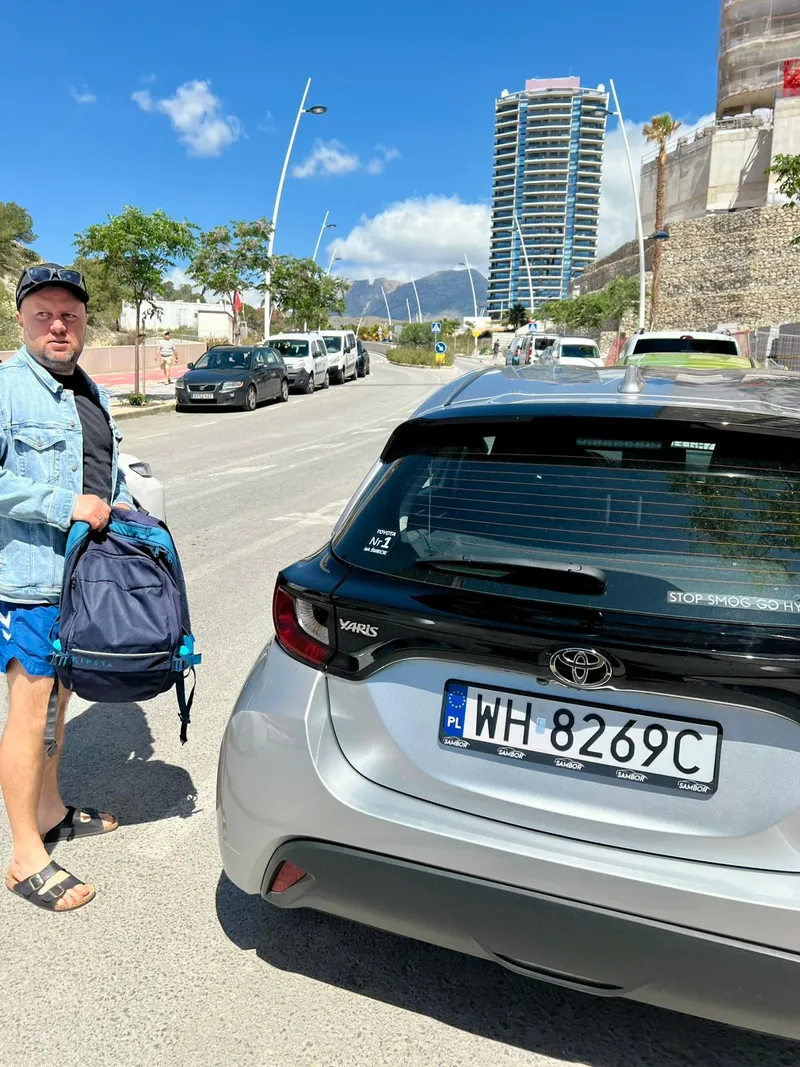
Toyota Yaris in Spain
Thank you, everything was great! :)

Mercedes-Benz E-Class Cabrio in Spain
it turned out poorly instead of a Mercedes I got a BMW4 convertible, I paid the deposit in cash when returning the car I did not receive cash back only after a week I was returned the deposit to my bank account. Greetings

Citroen C3 in Spain
It was Ok

Ford Mustang Cabrio in Spain
Overall, everything was great – I'm very happy with the service. I rented a car for two days, the Mustang was amazing, and I had a great time driving around Alicante and visiting friends. Everything went smoothly, for which I thank you very much. All the best 🤗
Where to drive from Alicante
A 100 km radius covers the whole Costa Blanca.
North — the coast
Benidorm is 50 km on the AP-7 or N-332, around 40 minutes: theme parks and long beaches. Altea sits 5 km further on with a pebble beach. Calpe at 70 km has the Peñón de Ifach rock. Jávea at 95 km is a gourmet town with quieter coves.
Guadalest
75 km and about an hour on a winding road. The clifftop village with its castle and reservoir view is the region's most photographed inland spot. Often paired with Altea or the Algar waterfalls.
South — Elche, Murcia, Cartagena
Elche at 25 km and 25 minutes: a UNESCO palm grove with 200,000 trees. Murcia at 85 km has the Mar Menor lagoon. Cartagena at 110 km has Roman ruins and a port.
Further — Valencia and Granada
Valencia is 165 km and 1h 45min on the AP-7 (parts toll-free since 2020). Granada at 360 km and four hours rewards an overnight, not a day trip.
The most popular pairing is a day in Benidorm and a day in Guadalest with a stop in Altea. Two completely different worlds in one trip.
If you have a spare night, Valencia works as an overnight. The AP-7 takes an hour and three quarters, with orange groves on both sides.
AP-7 or N-332 along the coast
The Costa Blanca has two parallel routes. The AP-7 is a toll motorway with light traffic, useful for longer hops (Alicante–Cartagena around €10–15, the Alicante–Valencia stretch partly toll-free since 2020). The N-332 is the free coast road — slower but prettier, threading through every resort town.
Simple rule: for a 1.5+ hour run point-to-point, take the AP-7. If your day involves stops (Altea, then Calpe, then Jávea), the N-332 is more practical and you lose very little time.
Alicante–Elche Airport works with most major hire companies. The big chains keep counters inside the terminal with cars in the airport garage. Some local brokers operate from off-airport lots 5–10 minutes away — a complimentary shuttle picks you up at a designated point in arrivals. It's a normal arrangement and often saves €30–50 on a week's hire.
A family of four booked off-airport, didn't read the email closely, and spent twenty minutes looking for a counter that doesn't exist. The supplier's number was in the confirmation. One phone call, shuttle in eight minutes. Save the number to your contacts on the plane.
The standard rule: AP-7 for the long legs, N-332 for the days with stops. The Alicante–Cartagena toll pays for itself with a single round trip.
Rates in Alicante vary throughout the year depending on the season and the rental length.
- January
- February
- March
- April
- May
- June
- July
- August
- September
- October
- November
- December
- Jan
- Feb
- Mar
- Apr
- May
- Jun
- Jul
- Aug
- Sep
- Oct
- Nov
- Dec
 How expensive is renting a car in Alicante: average daily rates for a one-week car rental, across all car classes.
What we do for customers

-
Clear pickup at El Altet
You know in advance whether you're heading to a counter inside the terminal or taking a shuttle.
-
Deposit and insurance visible before you book
No upsell at the desk.
-
Every car carries a DGT environmental sticker
Drive into Elche, Murcia or Valencia without a ZBE fine.
Parking, fuel, fines
Parking in Alicante
Street parking around the Old Town and the Esplanade is scarce. Underground car parks work better — Plaza Mar 2, Cervantes, Mercado Central, all at €2–3 per hour. The paid ORA zone runs Mon–Fri 9:00–14:00 and 16:00–20:00 (free during the 14:00–16:00 siesta). Green lines are residents-only — fines come quickly.
Postiguet and San Juan in summer
In peak summer, free spaces dry up by mid-morning. Paid car parks near San Juan fill by 11 a.m. The trick is to arrive early, or to leave the car a 10-minute walk away. The TRAM Alicante also runs straight to San Juan — sometimes faster.
Fuel and fines
The Spain-wide standard is full-to-full: collect with a full tank, return it the same way. Refuel away from the motorway (Repsol and Cepsa charge 15–20 cents more there) at discount stations like Ballenoil. The 50% early-payment discount on fines applies across the country.
A guest parked twice on a green line near the Mercado Central, thinking she'd found a miracle. Two tickets, €45 each. Pay within twenty days and the fine halves, but the spot itself is never worth the gamble.
A note on green lines
Visitors see a free curbside space, park, and walk into a residents-only zone. If you're unsure, go straight to a garage.
Frequent Questions
Major international chains have counters in arrivals with cars in the airport garage. Some local operators run off-airport — after landing you head to a designated meeting point and ride 5–10 minutes on a complimentary shuttle. The exact location and contact appear in your booking confirmation.
The AP-7 is faster and free of traffic lights, useful for longer legs (Alicante–Cartagena around €10–15). The N-332 is the free coastal route through resort towns — slower but better for days with multiple stops. For 1+ hour point-to-point, take the AP-7; for a touring day, stick with the N-332.
The full run is roughly €10–15 each way depending on the section and time of year. You can pay by card or cash at the booths or via a Vía-T transponder, but most rental cars don't carry one — confirm at pickup if it matters.
Tabarca itself is car-free, so you don't drive onto the island. Drive to Alicante port (15 minutes from the centre), park at Plaza Puerta del Mar or Plaza Mar 2, and take the boat: 30–40 minutes each way, four to five sailings a day in summer, fewer in winter. Buy tickets in the morning.
About 50 km and 40 minutes either way. The AP-7 is faster with no traffic lights; the N-332 runs along the coast through El Campello and Villajoyosa. Parking near Levante beach is paid; on the outer streets you'll find more free spots. The TRAM Alicante also reaches Benidorm if you'd rather not drive.
Yes. 75 km and an hour on a twisting road through Polop, with the clifftop Castell de Guadalest as a postcard reward — reservoir views, a small castle. Often combined with the Algar waterfalls or Altea. Parking at the village is paid (€2–3); cars aren't allowed within 200 metres of the entrance.
Elche sits 25 km and about 25 minutes south-west on the A-7 / N-340. The UNESCO palm grove — around 200,000 trees — takes a couple of hours to wander. Easy to combine with the airport return or with a southern run to Murcia. Centre parking is paid; outer edges of the grove have free spots.
Yes, but the day fills up. The AP-7 (parts toll-free since 2020) takes 165 km and 1 hour 45 minutes one way. Allow 6–7 hours on the ground for the City of Arts and Sciences, the Old Town and lunch. With kids or a slow lunch, an overnight is more comfortable.
Technically yes — 360 km and around four hours, usually via the AP-7 and A-92. But eight hours of driving leaves four to five hours for the Alhambra at best, which isn't really enough. With an overnight in Granada the experience is completely different.
There's almost no street parking around the Casco Antiguo and the Esplanade. Underground options work better — Plaza Mar 2, Cervantes, Mercado Central, all at €2–3 per hour. The paid ORA zone runs Mon–Fri 9:00–14:00 and 16:00–20:00 (free during the siesta). Green lines are residents-only — fines come fast.
In peak summer, free spaces near the beach are gone by mid-morning. Paid car parks fill by 11 a.m. Either arrive by 9–10 a.m. or leave the car a 10–15 minute walk away. The TRAM Alicante runs straight to San Juan and is sometimes faster than driving in.
The city itself is compact — the Esplanade, the castle, the beaches all in walking distance. A car in the centre tends to get in the way: one-way systems, expensive parking and the 30 km/h limit. Most customers use their car for trips out of town and walk or tram inside Alicante.
For July and August, book one to two months ahead — cars are still available but rates climb. Off-season (November–March) is 30–50% cheaper. May–June and September–October are the sweet spot. Easter week (Semana Santa) is unexpectedly busy, so book early.
After landing you head to a designated meeting point inside arrivals or just outside the terminal, where the shuttle driver meets you. The drive to the off-airport lot takes 5–10 minutes; paperwork and handover take another 15–20. The exact point and the supplier's phone number are in your booking confirmation.
Yes, one-way drops between major Spanish cities are standard. Alicante–Valencia is around €60–100, Alicante–Málaga €100–200, Alicante–Barcelona €150–250. Cars cannot be taken across to the islands (Mallorca, Tenerife). Book ahead — high-season prices and availability move fast.