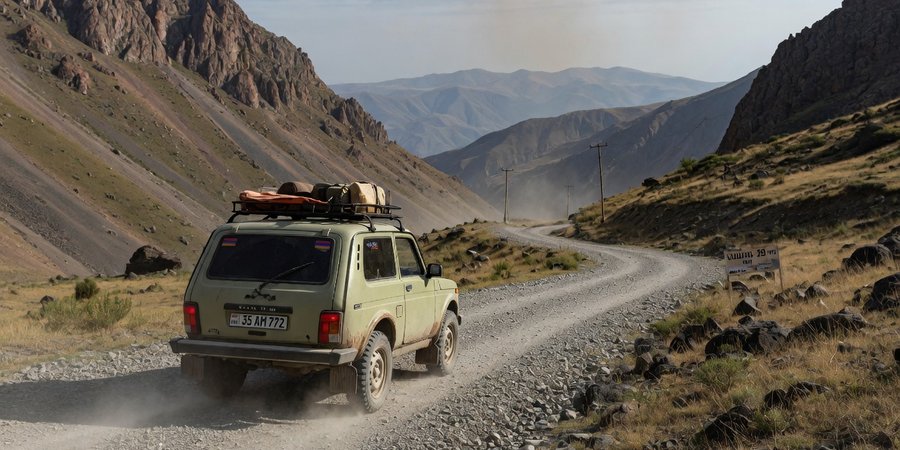
In Armenia, the Lada Niva isn't a nostalgia choice — it's a working answer to a real road problem. The country has more dirt tracks to interesting places than tarmac, and Armenian local drivers don't actually take their Honda CR-Vs up to the Geghama Mountains or the back roads to Tatev. They take Nivas. If you're booking a rental car in Armenia with serious mountain driving on the plan, the local choice is worth understanding before you default to a crossover.
What the Niva actually is
A small, square, 1980s-design 4×4 with a short manual gearbox, a low-range transfer case, around 200 mm of ground clearance and a 1.7-litre petrol engine. Front and rear differentials are mechanically locked through a centre transfer — proper four-wheel-drive, not the part-time AWD on most crossovers.
It's loud. The seats are basic. Air conditioning works but it isn't a lounge. None of that matters where you're going.
Where the Niva earns its keep
Three regions Armenian drivers consistently recommend a Niva over a crossover:
- Syunik switchbacks — the gravel approach to Tatev monastery, the Wings of Tatev cable-car station, and the unsealed roads south toward Meghri
- Geghama Mountains — high-altitude tracks east of Sevan, only viable by 4×4 from late May through October
- Aragats — Armenia's tallest mountain, with rough roads up to Kari Lake and the southern flanks
For Khor Virap, Garni, Geghard, Sevan, Dilijan and the standard tourist loop — paved end to end — a Niva is overkill. A Hyundai Elantra does it cheerfully.
A guest from Wellington last May had booked an SUV crossover, swapped at the desk for a Niva when the supplier described the day-three route to Geghama. Drove three days dirt, got 200 km further into the range than the original car would have. Returned with mud on the doors and a grin.
What it costs
$30–45 a day depending on season and supplier. Cheaper than most crossovers, much cheaper than dedicated Toyota Land Cruiser Prados or Mitsubishi Pajeros. Full coverage at $8–15 a day is sensible — the routes that justify a Niva also throw stones at it.
Demand is steady, especially in summer. The Niva fleet across Armenia is finite — by July the open slots for August disappear within two or three weeks. If your dates are firm, book three weeks ahead.
Caveats worth knowing
The Niva is a manual. If you've never driven stick, the mountains are not the place to learn. Some suppliers can find an automatic Suzuki Jimny or similar instead — ask. The Niva sips fuel for a 4×4 (about 10–11 L/100 km), but the tank is small at 42 L — fill up before leaving Yerevan, Goris, or Vayk because stations get sparse in Syunik.
Off-road insurance is its own conversation. Most CDW excludes unpaved roads, but Niva-specific contracts usually include an off-road clause. Confirm at booking, not on the gravel.
Bottom line
Tarmac and the standard loop? Skip the Niva. Syunik, Geghama, Aragats, gravel to a monastery nobody photographs? The Niva is the right tool, and the locals have known this for forty years.